
In the week prior to the start of the October moment of OUT.FEST 2021, we had the chance to talk to Vasco Alves - bagpiper for 'Os Belenenses' football club, member of VA AA LR and heroic investigator of acoustical phenomena and the materiality of sound, whose trajectory's been discreet but continuously fascinating, resorting to numerous sound sources and methodologies including synthesis and amplification techniques, tape recorders, signal processing and – more recently – bagpipes.
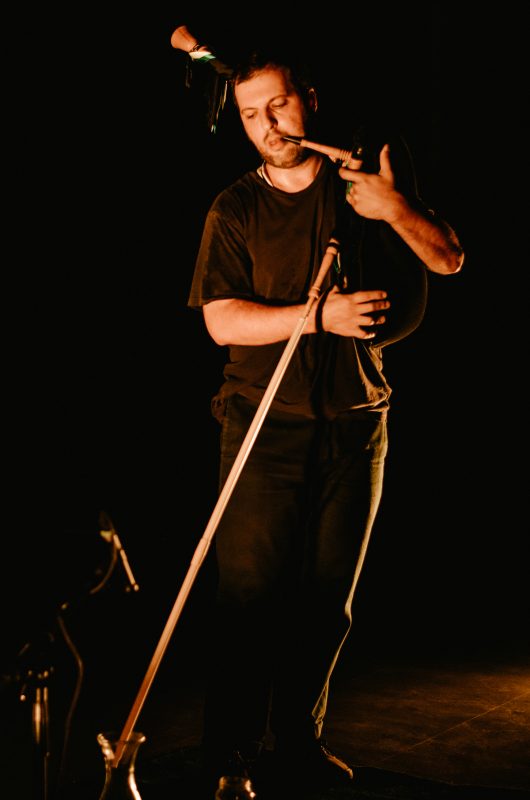
Can you tell me a bit about your experience with the bagpipes? How did you start playing them and how did your relationship with the instrument develop over time?
I started learning the bagpipes in 2014, at the Lisbon Galician Centre, and during the first years I had a traditional learning experience, but I always wanted to use the instrument in a less conventional, more exploratory way, closer to the themes I’m interested in, and that’s something I was only able to do a few years after I started playing the bagpipes. I think it was about three years ago, maybe in 2018, I started preparing a few pieces which, although they also include some electronic material, work on acoustic phenomena and psychoacoustics above all. I always try to explore some kind of effect within that field.
And what drove you to this instrument specifically? Because in 2014 you were already active in making music, right?
Yes, I had been playing for quite some time by then...I had two experiences which were somewhat surprising, so much so that when they occurred I didn’t even imagine I’d be learning an instrument one day. One was a concert by Paul Dunmall in London - he’s more associated with jazz and even improv as a saxophone player, but he has a personal collection of bagpipes from around the world. Me and a friend invited him to play at a concert we were organizing when I lived there, and he did a performance where he played with several bagpipes throughout, and there were some amazing moments in there that I wasn’t expecting, even in terms of the sound material...when the bagpipes were amplified, if you closed your eyes you could imagine it was a laptop concert, a computer music concert...well, there were some really surprising elements, and then when I returned to Portugal in 2014, I ended up attending one or two concerts where the instrument was also used, although outside this context, but then I decided to learn it, in a somewhat spontaneous way. And that was it, I liked it and kept doing it and at this point it’s possibly the instrument I work with the most, even though I also explore similar themes when I work with electronics.
On that topic, when did you become interested in electroacoustic music? Was there a specific moment when you discovered that kind of music and thought that was what you wanted to explore?
I don’t know if I can name a specific moment, I think that it’s probably related to the music I heard during my adolescence, which led me to have some interest in exploring, in following the more exploratory path in music, the less conventional one, so to speak. And in my university years, if I’m not mistaken, I learned how to make some contact microphones and some other small things (I think my first recordings were with that material actually, even if they were done in a very naïve and intuitive way), and well, things evolved from there, I kept being interested in instrument building, in exploring materials…Obviously, the things I’m interested in nowadays aren’t necessarily the ones I was interested in at the time, but it’s been evolving, going through several phases, although I think there’s something that unites them.
So what was the music you heard as a teenager that led you in that direction?
Well…in my early teens I listened to a lot of Sonic Youth (and all the musical scene they were a part of), that’s possibly one of the first times I saw instruments being used in a less conventional way. And going back to your previous question, there was actually a moment when I discovered Christian Marclay’s work, I saw one of his exhibits as well as some concerts and tapes, and I think that moment marked me somehow, also because of the way he used the materials and the sound that was generated by the things he built, the processes he explored and which were part of his pieces, all of those were very influential to me at the time. Soon after I discovered the great master, Alvin Lucier. There are many other things which have influenced me since, like the work of Rafael Toral, and Sei Miguel…But well, it becomes difficult to name specific influences, since I’ve been influenced by so many things.
The relationship I see between all of those musicians is in part related to what Eddie Prévost says and tries to teach others, which is to see an instrument as something to play “outside the box”, that you should be something of an explorer and improviser with instruments. On your website I saw the radio you played, and it looked familiar – were you at Eddie Prévost’s workshop [at OUT.FEST 2015]?
Yeah, I also used to take that radio to the workshops he organized in London, which were a weekly improvisation meet-up, every Friday night in a church basement, where everyone could show up and join, and for about two years I went there regularly, so that’s why I also participated in the Barreiro workshop that OUT.RA organized.
And what did you learn from those workshops? How did they help you develop your work?
I think those workshops had quite the impact on me at the time, but nowadays I don’t feel as close to or interested in free improvisation, which is basically what Eddie Prévost is focused on. Those workshops were an amazing thing for me at the time, both on a personal and social level, there was a dynamic which to me was new and quite exciting, the way the workshops took place and how people played there… there were small rules, but there was a lot of openness and fluidity and no-one ever told you what you should or should not do, and that fascinated me for a while. Meanwhile I think it lost a bit of…I don’t know if I became less naïve about that idea, or if I simply became more interested in other ways, other things…but I also experienced some incredible moments, there, with really great musicians, and I think that at a certain point, towards the end of the time I participated in those workshops, I would go there more to watch one or two people (like Seymour Wright) whose work I was interested in and fascinated by, and the five or ten minutes I’d hear them play would make the hours I’d spend there worth it…
You were saying that your interests started to change – can you tell me which part of music interests you the most right now?
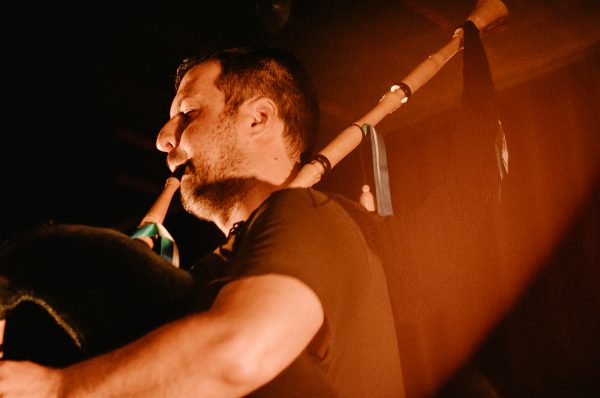
Well, about free improvisation: I think that’s not the core of what I’m interested in nowadays. My work, be it electronic or acoustic, always involved a lot of volatility and so improvisation is still very important to me, but I like to work on themes, be them things that came from working with an instrument (in the wider sense), from the “life” that volatility and instability can generate, but also spatial themes, of the connection between the instrument and the space, and trying to somehow find a way to create work which fits in this context. Improvisation is obviously always present, because I have structures but I don’t define what I do exactly, there’s space for me to react to things in the way that seems the most appropriate in the moment. The bagpipes themselves, being such a rough, primitive instrument in a way, and maybe the instrument’s limitations themselves, I think they’re a good way to explore this kind of ideas, because in a way I feel like that simplicity and rawness then allow others parts to come to the fore, to have some importance, be heard and perceptible, and the bagpipes end up being the trigger for those events, in a sense… trigger para esses eventos….
That brings me to another question – I notice that in your music, especially your most recent work, there’s a certain duality, between folklore, some very primordial stuff, and a more technologic and machine-like angle. I don’t know if that’s something you agree with…
It’s certainly not intentional. The tools I use often tend to define what I do. The bagpipes fell into my lap so to speak, like other things I’ve been using, and my perspective has been more like: “What can I do with this instrument, what does it give me, how can I apply it to what I’m interested in doing sonically?” In the concert I’ll be presenting at OUT.FEST, the computer is simply generating a frequency, a sawtooth wave, which has a very similar sound to the bagpipes, it ends up being almost like a second player, which then generates this clash of frequencies…It’s a bit hard to define, but like I mentioned I’m interested in exploring instabilities in the processes and mechanisms I build, and I try to do it with the bagpipes as well. But like I said it’s not a conscious decision, I like to work with rawness, I’m interested in a certain dryness in things and materials, and I move towards musical construction from there, to develop the work I do, but in fact, to me these are all things that fit mentally in the same place: to use the bagpipes or a synthesizer or a circuit I built or a radio, the ends to me are the same, there is no concept behind that.
You use the instruments because you really like their sound…
Yes, and because I’m interested in the rawness and brutality of things like white noise, or the sound of the bagpipes, which is also quite simple, in the simplicity in working with electronics, I’m really fond of all this…let’s say that the notion of economy, of doing a lot with meagre means is something I’m really interested in and that I strive for in the processes and things I create.
I wanted to ask you about the work you’ll be presenting at OUT.FEST, “Gaita Contra Computador” (“Pipes vs Computer”). The title calls to mind the idea of opposition, of combat, almost…You mentioned there’s a computer tone that’s really close to that of the bagpipes, can you tell us a bit more about that work of yours?
“Gaita Contra Computador” is the title of a CD I released last year, and yes, the work is based on the creation of a few pieces which are relatively short, some of which influenced the name of the album and which involve the bagpipes used without amplification in a space, while the computer is generating a frequency I programmed which generates tones that are very similar to those of the bagpipes, and the idea is that when frequencies cross in the space they create a some acoustic effects (like pulses, for instance)…My intention is to give listeners an impression that there’s a new sound emerging at a certain point, an union between the two sounds where eventually you stop being able to distinguish one from the other…but overall I’m interested in knowing how sounds cross in the space, it’s like I have another person playing with me there, but when you explore frequencies which are very, very close and you move around in the space there are small effects that come to being, in the acoustic space in this case, the concert venue.
Then I might present some acoustic pieces as well, without the computer, where I explore the bagpipes and their physical limits, I try to pull the pick to sound registers which aren’t exactly the ones the instrument is meant to reach, looking for flaws and exploring those flaws and that instability. Then there’s another piece which involves adding a tube to the bagpipes and pointing that frequency to a few jars on the ground, and explore the jars’ resonating frequency – when you bring the sound of the bagpipes closed to the jars a new frequency emerges, and it’s a piece focused on that interaction…and my concert will explore these ideas – they are pieces which somewhat resemble what’s going on in the record but which are in constant evolution, every time I present or rehearse them they are adjusted and mutate over time.

And the space itself influences the way the pieces sound like – I remember, for instance, having had Erwan Keravec play in Barreiro, and he was very happy with the natural reverberation and amplification of the church he played in…How has your experience been like in playing in different spaces, do you also feel like it has had a big impact in the way you play?
Of course, it always does, not only in acoustic pieces but also in the ones I use the computer in…the resonance of the space tends to make the pieces sound a bit better, I think, they might not work as well in a very dry space…I could be forced to think of something else, but yes, the acoustics of the space are really important, it’s something I always have to keep in mind every time I play, and in this case I’ve already been to the library [the Municipal Library of Barreiro, where the show took place], to check it out and try playing there, and that ends up influencing what I’ll present somewhat…
You were telling us how you’re really interested in intensity a while back. I wanted to ask you about “Estrada Longa” [Long Road] – I was listening to it a few days ago and felt that it had something close to motorik, not so much in the rhythmic sense of krautrock, but as a certain propulsion and trance, not in an intense way, but conveying motion, and the bike ride…Which is what inspired “Estrada Longa”, your trip on the N2 on a bike in the middle of the pandemic, right? Can you tell us a little about your trip, and how that influenced the record?
Yeah, that was it. I made the trip on my own on a bicycle, and at the time I hadn’t planned to make anything out of it, I simply started riding and seeing tonnes of place names that I liked, and so I decided on the first day to start recording the names of the places I passed through. Almost all of them, although I didn’t do it constantly – first I’d pass through a few, record it on my phone, then I’d go a little further and record some more, and by the end of the trip I had almost 150 place names recorded, from Trás-os-Montes to the Algarve.
Then I spent some time thinking about how to use that material. Those were phone recordings, and often I was pedalling as I recorded, so even though I thought they were interesting I couldn’t quite get them to fit, and so I concluded that the raw material wouldn’t be as interesting (even though I find that aspect interesting as well). What I ended up doing was to grab a pair of synthesizers I had at home and which I use often and which basically allow you to create a sort of patterns with a lot of instability and volatility due to the way they are connected, there’s a cyclical aspect to it, but non-linear in a fashion, and I thought that the two things could be joined, so I created other patterns, one for each day of my trip, and I re-recorded the names of the places I passed through each day.
And that’s how the record came to be – as you mentioned, there’s that cyclical aspect of the synthesizer, and I wanted to get a sense of monotony across as well, I was interested in that idea of long days, of never-ending but constantly mutating roads…that’s how the pieces emerged and they had that final result, the album. I’m not sure if it makes sense to follow up with it, I think that work ended there, with that piece, which sometimes I think could have been longer: instead of 50 minutes it should be four hours long, but that’s how it ended up like…
The last question might be a bit of a silly one, but: how did you become the piper for Belenenses [a football club based in Belém, Lisbon]?
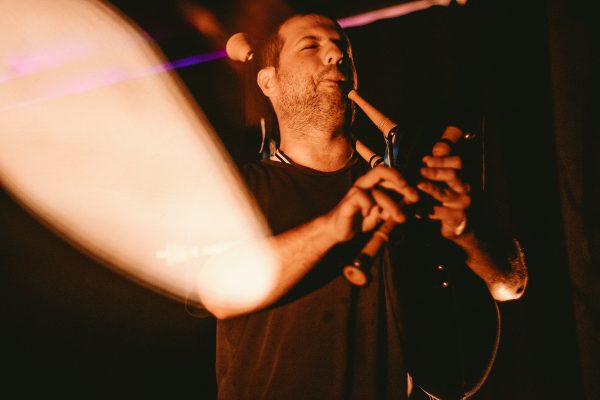
(laughs) My connection with Belenenses comes from my family, my grandfather and great-grandfather were from Belém, I’m a supporter since I was born, etc…The club was recently relegated to the last division, because of the conflicts with B-SAD, and the first time they played after that I decided to take the pipes with me. I had already spoken with some friends who were connected to the supporter group, and I started playing the club’s anthem, everyone started singing in the stadium, and at the end of the day there were already videos on YouTube connecting that moment with an old tradition of the twenties, the Belenenses’ fifteen minutes – supposedly the club made a series of comebacks in really important games that year, including a famous one against Benfica. And so for many years the supporters would make a lot of noise in the last fifteen minutes, I heard that with whistles and pans, and someone connected my playing to that tradition, so now during games, in the last 15 minutes, I play the anthem and some other supporter group (the Fúria Azul) songs, and it became something regular in the games. Now I feel that I have this responsibility, so every Sunday I’m at the stadium with the bagpipes, there’s two of us playing them right now actually…so yeah, that’s where the bagpipes-Belenenses connection came from.
That’s really cool. You weren’t aware of that tradition yourself, were you?
I did, my grandfather told me as a child, but it wasn’t with the bagpipe you know, he just said that they used to make a lot of noise in the stands, or they’d play a whistle three times, but meanwhile that completely died out, there’s even books in the 60s of people connected to the club who mention that players didn’t know what the Belenenses’ fifteen minutes were anymore…and that was in the 60s, in the 90s I’d still hear a few whistles, but it was practically forgotten, and now it has some meaning again, it’s funny.
Interview by Tiago Franco and Diogo Carneiro. Pictures by Pedro Roque (the first one) and Nuno Bernardo (the remaining).