Viegas - Interview

Part of the impressive mina collective, participant in the Rabbit Hole parties and, for some time now, member of Rádio Quântica, Viegas is a Barreiro-born artist and DJ who was a part of OUT.FEST 2019's closing night at the A4 space. Before the festival we had the chance to speak with him about his artistic path and his activity in the collectives he is a part of in an interview you can read below.

How and when did you discover techno and electronic club music?

In 2014 I spent a few months outside Portugal, in Barcelona, and my way of getting to know the city and its people was by going out at night. Burial’s River Dealer had recently been released at the time and that ep was also a gateway to electronic music for me, especially for the musical scene in the UK, but to other things as well.

What kind of clubs and nights out did you usually go to, after that formative period? Usually here in Barreiro and in Lisbon I suppose?

In Barreiro my nights out were usually in the streets…but in Lisbon I’d go to Lux, as well as some Rabbit Hole parties and Príncipe nights.

Before we talk about your collective, I wanted to ask you about the Rabbit Hole nights, as they were parties which despite being associated with dance music were very eclectic, I even saw a friend of mine who plays drone music perform at one. Do you feel as if that mix of different music genres influenced your way of being a DJ?

In a way yes. At Rabbit Hole there was a place for all kinds of artistic expression, everything could be a part of one of those nights. That eclecticism in programming might have influenced me, yeah. Growing up in the suburbs also had a large impact in my way of looking at electronic music and in my interests. I grew up listening to Kuduro and Kizomba well before Techno or House or any other style…so lately my work has been in figuring out how to mix the many reference points I have into something appropriate for the moment when I’m playing.

Moving on to mina, how did it come to be and how did you join it?

Mina started after Rabbit Hole and Rádio Quântica (another project that I joined a little while after I started working with Rabbit Hole) joined forces. At the time Lisbon lacked an electronic music night that provided a space for people to experiment with their identity and sexuality…where rules were…implied and based more on mutual respect than those rules usually associated with more institutionalized spaces. Pedro Marum, one of Rabbit Hole’s founders who also joined Rádio Quântica around the same time I did, had the idea to start these mina nights with Violet and Photonz, the founders of Rádio Quântica, and since I was working with both projects I was invited to help out.

Speaking of Rádio Quântica, do you still have the “Mercúrio” radio show?

Well I’ve since changed the name to rave3000, and lately I haven’t done the show as often, but yeah.

How different are the playlists you make for radio shows and the ones you play on the dance floor? What are the differences and similarities, and what do you try to bring to one and the other?

Maybe I’ll start with the similarities: it all comes from the same place, I have similar criteria for both and I try to be inclusive and always focus it away from the centre. I don’t have as many concerns with the show, if the music is danceable or how it’ll be received, so I think it’s a much more experimental space with much less expectation from listeners. I always try to share the slot with other people as well, so it changes depending on whom I invite. On the radio, to me, the most important thing is to give other people a chance to access the platform, and I’m sure that if Rádio Quântica didn’t exist things would have been much harder for me.

You’ve played outside Portugal several times, in Berlin for instance…

Yeah…this last year I had the chance to play in several European capitals, like London, Paris, Athens…

Those are quite different cities, and known for their night life…how do you think Lisbon compares to those places? Is there anything unique about the city in that sense?

I feel more comfortable in Lisbon, so I am freer to experiment with some things. Usually I play in contexts where audiences are used to hearing all sorts of music and where that diversity is celebrated. Maybe this convergence is more normal because we don’t have as big a variety of nights dedicated to specific genres. In London, for instance, I felt the same, but in the UK there’s a very rich and diverse history of electronic music. I’m not sure if it’s unique, but since it’s a smaller city it’s easier to meet people from different scenes.

You studied documentary cinema, correct?

I started out studying Advertising and Marketing at the Escola Superior de Comunicação Social, but I quickly realized that wasn’t what I wanted to do, so I went on a one year Documentary Cinema course and studied Photography at Ar.Co and at the Fine Arts faculty.

I know you photograph the mina and Rabbit Hole nights. Do you feel that some of your education influenced your work? Not just as a photographer, but as a DJ as well?

I think it was the other way around, it was clubbing that ended up influencing my work in photography. My interest in photography arose from going on nights out because I felt the urge to create a record of what was happening. Now, I don’t know, in the future I’d love to explore the visual component of my shows more, so maybe it will change and photography will start influencing my way of DJing.

Coming back to Barreiro – You were born and grew up there, and according to one of your posts you would hear the festival from your bedroom. Can you tell me about your OUT.FEST experiences, starting from that moment in your bedroom?

I was living close to Ferroviários at the time, and the festival happened there several times. So I remember being younger and being unable to classify the kind of music I was listening to, and that was always interesting to me. When I started going it was very important for me to understand that there were other musical languages and possibilities…to see people with very creative approaches to their instruments and a patient and receptive audience. To discover ambient and drone legends who I would likely never cross paths with otherwise, all of this in incredible places that go unnoticed during the rest of the year. The kind of music I hear at home when I’m not preparing a set is very much influenced by what I hear at OUT.FEST.

Do you have a mix specifically prepared for OUT.FEST? What can we expect in one of the festival’s closing performances?

I’ll try to stay close to recent releases. I want it to represent what I’ve been listening to and playing in my latest sets somehow, prioritizing more experimental music that might not work as well in other contexts. I want to go to many places…but we’ll see what happens!

Interview by: Tiago Franco
Angélica Salvi – Entrevista

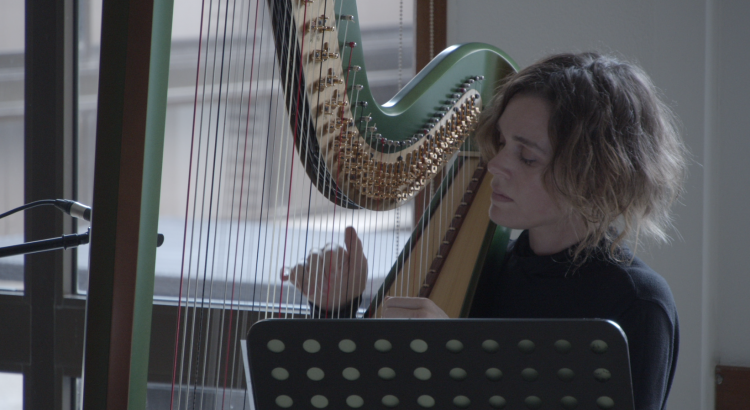
Angélica Salvi is a Spanish harpist who’s been based in Porto for a few years and who has produced exploratory work with her instrument with a truly heterogeneous variety of musical and transdisciplinary collaborators, albeit essentially focused on improvisation work. In addition to teaching at the local Music Conservatory, she has performed as a soloist with the Porto Casa da Música Symphonic Orchestra and the celebrated Remix Ensemble.

In her collaborations with iconic musicians such as Han Bennink and Evan Parker, in her work on stage and in her records, her vocabulary is ever adapting, though always maintaining its identity, working the timbres and effects according to contexts and ideas.

We had the chance to speak with her before her performance at OUT.FEST 2019, and we invite you to read the result of that conversation below.

When and why did you move to Portugal? What made you head to Porto, specifically?

I was living in the Netherlands, where I was studying, and I received an e-mail from one of my teachers saying that they needed someone to teach the harp at the Porto Conservatory and asked me if I was available. I thought, why not? So, in September 2011 I moved to Porto, going to the Netherlands once a month to finish the Masters’ degree I had started there.

How long ago did you start playing the harp?

I play it since I was 11.

And what made you focus on this specific instrument?

It was a coincidence. At the time I had started studying the piano. I went through the tests to study at the conservatory and when I was accepted, I chose the piano as my first option and the harp as the second (because it was the closest instrument to the piano). There weren’t any openings for the piano class, so I started studying the harp. And I liked it, even though I didn’t know the instrument well at the time.

It’s your main instrument, but was there any time you decided to change instruments, or were captivated by another one?

I had a piano at home (my mother studied and played the piano) and there was a time when I played both the piano and the harp, and in my opinion both instruments have a lot in common. Even though I like other instruments besides these two a lot, I never decided to seriously focus on any of them.

When did your interest in improvisation begin? It’s not usually something that’s taught in schools, especially for the harp…was there any moment, or an idea, artist or concert which led you to this approach to music?

Well, I was always very interested in creative, artistic pursuits in general. I studied fine arts for three years, I love drawing and always liked making up new things. At school I had a very conservative education (though fortunately they changed it up a little later on) so I had to search and explore on my own. I was looking for some kind of freedom and the only alternative I found at the time (which went beyond written music) was Jazz. I had some jazz lessons, I met a harp teacher who taught jazz at the University of Arizona and I studied under her for a year and a half. Then I continued my studies in the Netherlands, at the Conservatory and the Dutch Impro Academy, where I met the ICP Orchestra musicians and the Brokken-Fabriek (in Amsterdam) and that’s when I discovered the world of free jazz. So, I’ve been active in improvisation for several years now.

I spoke with Peter Evans a few days ago and he told me he always finds it difficult to teach people the “right” way to play music, and that his way of teaching is not so much to show how you “should” do something, but rather to serve as a guide to new musical possibilities. Do you share some of his doubts about the best way to teach music and the harp in particular? How do you guide your students in their learning?

I always have many doubts…As teachers we’re always learning from our students. I also speak with many colleagues and my students often so we can try new methods and formulas. Some of my students are very young, so I have to find a balance between the creative and theoretical parts. On one hand they have to learn the theory (even if that may be a little repetitive and monotonous at times) in order to be able to reach a certain technical and positional level required to master the instrument. Sometimes it can get complicated because it requires a lot of patience and consistency. It’s kind of like a martial art.

Searching for that balance is the difficult part. It also depends on the specific person and their personality, so it’s important to adapt the classes to each student and understand what they like or what they feel more comfortable with.

But other than that yes, I agree with Peter Evans: a teacher should serve as a guide to new musical possibilities!

Do you have any new projects which you’d like to tell us about?

I have several ongoing projects, they’re all on my website: www.angelicasalvi.net.

You’ve collaborated with several Portuguese musicians, like Rafael Toral – do you feel as if there’s a way of seeing music – particularly improvised music – which is unique to Portugal? Of course everyone has their own personality, but do you think there’s something special about this community in Portugal and their approach to music?

You’ve collaborated with several Portuguese musicians, like Rafael Toral – do you feel as if there’s a way of seeing music – particularly improvised music – which is unique to Portugal? Of course everyone has their own personality, but do you think there’s something special about this community in Portugal and their approach to music?

I had a feeling (especially when I lived in the Netherlands) that lately there’s a tendency to specialize: in education, in arts…it’s as if an artist needs to have a very specific predefined style, even with certain rules, in order to fit in somewhere or being labelled as something (a lot of record labels pressure their artists with this kind of thing). But I think that’s the wrong path to follow because the end result becomes overly formatted, globalized and boring…that’s why I feel very happy in this country, I think artists preserve and protect their essence a lot and the really believe in what they do. That’s the experience I had with the circle of musicians that adopted me.

Interview by: Tiago Franco


OUT.FEST 2019 - Final additions to the lineup

Here is the final lineup for OUT.FEST 2019, the 16th edition of our annual gathering for sonic discovery.

Between October 3rd and 5th we will be presenting 26 concerts in 9 (!) different venues all over Barreiro, many of them for the first time in the festival's history.

Both the global passes (which are flying off the shelves) and now the day tickets are available online through BOL and in FNAC, WORTEN and CTT stores, as well as BOL's other partners throughout the country.

Find out all about the newcomers to the lineup below, and discover everything else (including venues and schedules) about the festival at outfest.pt

OUT.FEST 2019: Dates announced and early bird tickets for sale

We are now on the road to the 16th edition of OUT.FEST - The Barreiro International Exploratory Music Festival, which this year will happen from October 3rd to 5th in (as usual) several venues throughout the city - some of which making their OUT.FEST debut - with a particular focus on Barreiro's city centre.

With the first artists performing at the festival soon to be announced, you can now purchase the early bird all-day passes for OUT.FEST 2019 (limited to 100 units) at the very special price of 16€.

Be sure to mark these three days of musical discovery on your calendar.