OUT.FEST 2021 - Lineup change / Day tickets now available

There’s less than a week to go until the start of the first part of OUT.FEST 2021, whose lineup will regrettably have one change from what was originally announced. Due to recent health issues, IANCU DUMITRESCU’s concert with the Barreiro Ensemble will not take place on June 3rd as scheduled. Instead, we intend to present this show during the festival’s second moment, between the 5th and 9th of October.

However, we are happy to announce a new concert for that evening: taking the stage at the Augusto Cabrita Municipal Auditorium at 20:45 will be theRAFAEL TORAL SPACE QUARTET, a group which has just released their already widely acclaimed new album ‘Directions’ This will be a symbolic moment in the history of the festival, seeing as it marks the artist’s return to the place where he made his OUT.FEST debut in 2006, with his then almost brand-new Space Trio.

Day tickets for this first instance of the festival are now also available for purchase at outra.bol.pt for 10€ (good for both the afternoon and evening concerts). Passes are also still available - but only 30 of them remain, so hurry!

"Fragmento" by José Bica - a sound installation at the EMEF balconies

Our return to activity continues with a sound installation which brings the Cidade Som archive to the fore through the work of one of its main contributors, José Bica, a musician and sound artist from Barreiro.

Fragmento ("Fragment") is a multi-channel, open-air sound installation, active on the next Saturday, the 22nd, between 11h and 19h at the iconic balcony of the EMEF building, at the art of the Miguel Pais street - a place full of symbolism related to the city's railroad heritage, as well as a meeting point with its riverside.

Admittance is free of charge, albeit limited to the the space's capacity at any given point. "Fragmento" is part of the intermunicipal initiative Mural 18.

"Fragmento" is part of the intermunicipal initiative Mural 18.

OUT.FEST: programme for June announced, passes on sale now

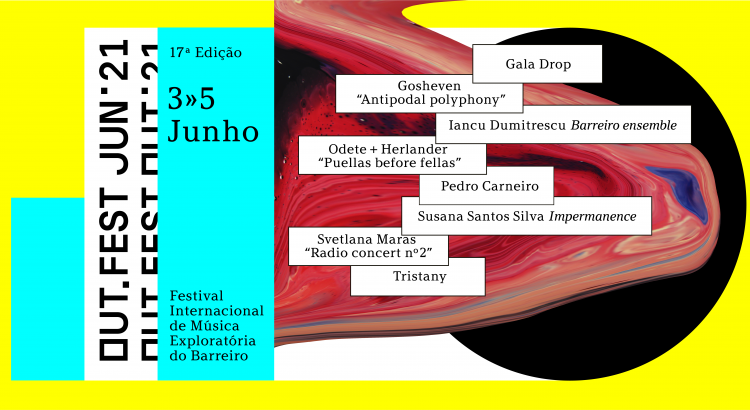
After a year-long forced hiatus, OUT.FEST is back for its 17th edition, this year divided in two moments.

Between June 3rd-5th, the center of the action will move uptown, with concerts taking place at the open air auditorium of the Paz e Amizade Park (every day at 18h) and the Augusto Cabrita Municipal Auditorium, in the neighbouring city park (every day starting at 20h45).

It is, as always, a demanding year (full of unexpected challenges one could hardly foresee at the end of the glorious 2019 edition of the festival), yet, also as usual, a year in which we rise up to present circumstances to allow new entry points into the (un)known Barreiro and strive to foster, as much as possible, a sense of proximity in times of physical distancing - and what better way to promote that proximity than through shared sonic experiences?

During this year’s first OUT.FEST moment we will present eight shows, three of which associated with the UNEARTHING THE MUSIC (www.unearthingthemusic.eu) project which has, since 2018, been discovering, analysing and compiling the music created at the edges of the European dictatorial regimes of the second half of the 20th century (in which, obviously, Portugal is included, but also Spain, Greece and all eastern Europe); and we introduce a new European project, REMAIIN (www.remaiin.eu), which promotes European experimental music with roots in other parts of the world and which brings to Barreiro a concert and an associated lecture; finally, we will also showcase four Portuguese bands/musicians with their eyes, ears and minds turned towards the future, one of our defining activities since OUT.FEST’s (and OUT.RA’s) inception.

Sit down (on the marked seats), put on your masks, and open your ears. OUT.FEST is back!

Find out everything here: www.outfest.pt

OUT.FEST 2021

We are incredibly excited to finally announce the 17th edition of OUT.FEST, which will take place twice this year - once at the beginning of June, and then, as usual, at the start of October.

This will be an OUT.FEST adapted to our current situation, but a true, live OUT.FEST nonetheless, taking place in both well-known and lesser known spaces - an intimate way to experience Barreiro and feel as close to it and each other as possible within the rules and laws of the world in 2021.

Save the dates: June 3rd-5th and October 5th-9th!

We'll be back soon with more information and the full line-up for the first instance of the festival this year - it's very close! 

(Another) return to the stages

Now that a return to cultural spaces has become a possibility (even if a tentative one) once more, we waste no time in announcing our next two events: the public presentations of the work of last year's recipients of the OUT.RA Creation Grant, both of which serve as a symbolic end to 2020.

On the 24th of this month, at 11h, the third and last public presentation by ZIMA (Sara Zita Correia and Marta Ramos) will take place at the Madre de Deus da Verderena Convent - a chance to encounter free exploration in a "dream" format once more. In the artists' own words: "Exchanging the eve of the solstice with the eve of freedom, we open the gates to a new place, to share another life experience. This time, we're interested in chasing a moment which reinforces the simplicity of existence and exposes the inevitable rawness of the meeting between plain voices and the walls. ZIMA presents its dream, in the last public moment of Marta and Sara's project while under the OUT.RA Creation Grant".

At 21h on May 13th, in AMAC, we'll be able to see the work of filmmaker CAMILA VALE - “Solo Infértil” is the film she created throughout 2020, with the participation of several leading local representatives of the worlds of sound and image. "When something odd goes on in the soil, Laura and Miguel's curiosity blooms. The siblings' fascination with the inexplicable colors of the earth, and the secrets hidden by the past, leads them to create an harmony for their dissonant reality in the space they live in. Between disquiet and discovery, one can tell that the world, in these children's eyes, can be a place to imagine, even when nearing its end."

Admittance to both events is free, although a prior reservation (made by e-mailing info@outra.pt) is required.

It goes without saying that the use of a mask and regular hand disinfection is still mandatory - a small requirement for a return to these moments we've all been missing.

OUT.RA LOCAL CREATION GRANT 2021

After analysing the numerous and generally outstanding applications we’ve received to the 2021 OUT.RA Creation Grant, this year we have decided to select two projects as recipients of this grant:

André Neves (also known as George Silver), a Barreiro musician with a growing reputation for his artistic work, will work on a new album (his second LP) which will feature a diverse cast of guests.


Vera Marques (aka Puçanga), a multidisciplinary artist resident in Seixal (one of the neighbouring municipalities recently included in the scope of the Grant), will develop a “vocalgraphic” investigative and creation project by bringing together several vocal circles, a work which will also be released as an album.

This annual grant has been awarded since 2016 to musicians and audiovisual artists residing in Barreiro and the surrounding urban areas in order to create and present original works. This year, each of the selected projects will be supported with 1000€ in order to achieve its aims and host at least one public presentation of the work developed.

Throughout the following months we'll be revealing more details regarding the selected projects and their journey towards completion.

"INDÚSTRIA" - new album by AMM, recorded live at OUT.FEST

While waiting for our chance to once again bring live shows to Barreiro, we've been actively working behind the scenes to bring you some exciting news we've been eager to share with you. One of them is the latest release by AMM, the legendary British free improvisation outfit, whose 2015 concert at the Baía do Tejo Industrial Museum, part of that year's edition of OUT.FEST, has now been released by the Matchless label, itself a key institution in understanding the history of improvised music throughout the world.

"INDÚSTRIA", ("Industry") a name chosen by percussionist Edwin Prevost in tribute to the history behind the building where the concert took place, is now available at Matchless' website. This release has been enriched by photos by Vera Marmelo and several texts, one of them written by OUT.FEST co-director Rui Pedro Dâmaso.

Don't miss out on this chance to grab a piece of the history of AMM, improvised music, and, of course, Barreiro. 

Kontraklang: The Cosmic Music of Teiji Ito

Release date: 03/15/2021

Concert series Kontraklang – REMAIIN’s Berlin partner organization – focuses on the film music of composer Teiji Ito for its first activity as part of the project. A lecture performance/film titled "The Cosmic Music of Teiji Ito", created by Michiko Ogawa and Manuel Pessoa de Lima, will be published online on March 15.

The groundbreaking experimental films of Maya Deren and Marie Menken rightly enjoy cult status among connoisseurs. The music of these films, on the other hand, is largely unknown, despite being an essential componen. Originally planned as a live concert in which Teiji Ito's works would be performed for the first time in Berlin along with the screening of the films, Michiko Ogawa and Manuel Pessoa de Lima are now realizing their lecture performance as a video work that will be accessible online free of charge. In it, the two artists interweave aspects of Ito's, Deren's and Menken's work with biographical details, absurd background information on the creation of the films and music, as well as their influence on experimental art in the mid-20th century to create an associative collage.

The main points of reference are four films and their soundtracks by Teiji Ito: Meshes of the Afternoon and The Very Eye of Night by Maya Deren, as well as Dwightiana and Bagatelle for Willard Maas by Marie Menken. Ito originally conceived the music as "aural scores": he recorded all the instruments himself on tape, one after the other, and then superimposed the recordings to create the finished piece, rather than notating the music and having an ensemble play it. The composer drew musical influences from a variety of genres, practices and styles, including Japanese gagaku, flamenco guitar, Andean folk music and Western classical music. The soundtracks were transcribed by ear as part of Michiko Ogawa's research, making them accessible for further artistic exploration for the first time.

The film "The Cosmic Music of Teiji Ito" is expected to be released via Kontraklang's website and social media channels on March 15, 2021, and will then be available online free of charge.

The film "The Cosmic Music of Teiji Ito" is expected to be released via Kontraklang's website and social media channels on March 15, 2021, and will then be available online free of charge.

More information will be available shortly at www.kontraklang.de, www.remaiin.eu or via social media.

Interview with Erwan Keravec

Erwan Keravec is a Breton piper whose eclectic path ranges from traditional to contemporary music and improvisation. This encompasses playing solo music written for him by a wealth of contemporary composers, leading a piper quartet, improvising with key figures of european jazz and writing and playing music for modern dance and theatre companies. He performed at the Nossa Senhora do Rosário church in Barreiro on July 2019, and after his soundcheck he took the chance to interview him. You can read that interview below.

Hi Erwan, can you tell us more about your background as a musician and how you chose the bagpipes as “your” instrument?

I grew up with traditional music. My parents were dancers in the traditional Brittany style, with traditional music from Brittany, and when I was a child the first instruments I heard were the bagpipes and the bombarde, a kind of oboe. I learned to play the bagpipes in their traditional context for marching and dance. One time I played with an orchestra in Bern with bagpipes, snare drums and the bombarde and we met a jazz big band. That was when I improvised with the bagpipes for the first time, and after that I decided to focus on improvised music, even though my background is really in traditional music.

Have you tried other instruments in the bagpipe family, from other musical traditions? How would you compare them to your own?

Two years ago I played in a trio with three bagpipes: one from Algeria, another from Iran and mine, from Brittany. And my idea at first was that the three bagpipers would play solos, and when we were practicing of course we tried each other’s bagpipes, and it wasn’t very easy (laughs). It’s not the same fingering, of course the system of breathing is the same, but the fingering is totally different, so it’s not very easy to play other kinds of bagpipe…I focus on the one from Brittany exclusively.

You’ve been touring with your ‘Revolutionary Birds’ trio (with Wassim Halal and Mounir Troudi). How did this collaboration come about?

Revolutionary Birds began as a commission by two festivals, one in Beirut, Irtijal, and another in Paris, la Voix est Libre, and the idea the two directors had was to mix music from Iran, Lebanon, Tunisia and Brittany. It was not our idea at first, but after that the three of us decided to take this idea and to tour with it. For me this is different from what I usually do - when I play solo, in duo, trio, etc, it’s always my idea, but this was the first time I played in someone else’s idea. At the beginning I was like “ok, what kind of band is this”! We work a lot with percussion right from the start of the composition, so the structure of our music is all based on the bagpipe and the percussion and the voices come after. But it’s not what I usually do - usually I take an idea from beginning to end, so this is different for me.

How have the trios’ performances been received so far? Have you been getting good receptions by the audiences?

Yeah yeah, in all kinds of different contexts, even in rock music festivals. We don’t really play rock music but it’s not world music either…I don’t play music from Brittany, I just play the bagpipes from Brittany, and the singer, Mounir, doesn’t really sing Tunisian music either. He does some Mawwal, which is improvised music from Tunisia, but it’s not a song, it’s an improvisation. So, in traditional and world music festivals, the reception is good and in new music festivals, it’s the same, so…it’s strange. (laughs)

Today you’re bringing us your “Urban Pipes” performance – can you take us through the idea behind it, its guiding principles and aims?

At the beginning, in 2007, the project was only for recording, and at the time I didn’t want to play this music in concert, I just wanted to record. Being a solo bagpipe player is the traditional way to play the instrument, and when I decided to do this it was because I wanted to make new music on the bagpipes. So, I took the traditional form of this instrument, the solo bagpipe, and two years after when I started to play concerts, I decided to play just one piece and move around a lot, change a lot… After my second record I had changed a lot and kept composing and…”Urban Pipes” is…my conception of what bagpipe music is, what I can do with them.

When I decided to do this, I wanted to make music without any reference to traditional music. Is it possible for the bagpipe to be just an instrument on its own, not an instrument exclusively used in traditional music? What can new music for this instrument be like? That’s what I was after, but it wasn’t that easy because I grew up in that same tradition, so my ability to imagine music is of course influenced by traditional music. It’s really different now because I work a lot in new music, in contemporary music, so I can think about music differently now, but in 2007 it was really different… the traditional music in Brittany is the music of the countryside, not of the city, and when I decided to create this new music I tried to see what could be urban music for bagpipes.

Have you performed in churches before?

Yes.

Did you enjoy the experience?

Yes, of course!

Why is that?

Because the sound is really loud, there is a lot of reverberation. The sound can be everywhere, so it’s possible to have it come from the front, from the back, and churches are really wonderful for that, of course. And the sound is loud, I don’t really like to play outside because there are no walls there, there is no reflection, and in a church, reflections are everywhere, so… I love playing in churches.

How do you feel about this church and its acoustics?

It will be loud (laughs)…it will be loud. But that’s good! (laughs)

OUT.RA Local Creation Grant for 2021: Applications open

Picture by: Vera Marmelo

OUT.RA – Associação Cultural is now accepting applications to its creation grant by young local artists who want to develop artistic work related to music / sound / sound art / multimedia during 2021. This time, we've decided to expand the geographical range of potential applicants by allowing residents in the neighbouring Moita and Seixal municipalities to apply for this grant, set at 1000€.

Since 2015, the OUT.RA Local Creation Grant has supported artists like Tiago Sousa, Van Ayres and Camila Vale. 

You can read all the necessary information regarding this grant below. Applications are open until January 31st 2021. We're looking forward to receiving your projects!


OPEN CALL

OUT.RA LOCAL CREATION GRANT 2021

The criteria considered in selecting a project for this grant are as follows:

  • Resident in the Barreiro, Moita or Seixal Municipalities;
  • Age between 18 and 35 years old;
  • Education (higher or technical) in artistic fields, particularly in Music / Sound Art / Multimedia / Ethnomusicology, or alternatively relevant work already developed in Music / Sound Art which reveals an interest in seeking new solutions and an idiosyncratic artistic personality;
  • Awareness of the work developed by OUT.RA (OUT.FEST, regular programming, sound documentation, etc) and degree of project fit with said work;
  • Conceptual quality of the creative project, level of maturity presented in regards to its development, feasibility of the presentation in terms of means necessary towards realizing them.

The work developed by the recipient of the grant should take place between April and December 2020, and have at least one public presentation as part of its outputs.

This grant is set at 1000€.

Applications should be sent to info@outra.pt up until January 31st and contain the following information:

  • Name, CV and artistic biography;
  • Project description and calendarization.
  • Materials necessary for the development of the project.

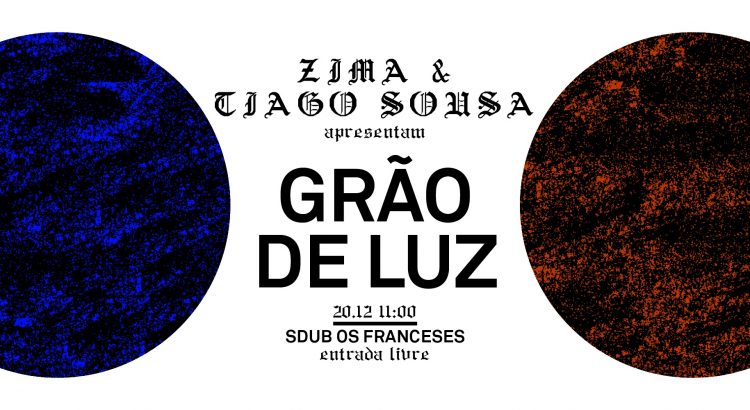
Domingo: ZIMA e Tiago Sousa apresentam ‘Grão de Luz’

O nosso 2020 acaba já no próximo domingo, com a apresentação, às 11h, n’Os Franceses, do segundo momento do trabalho desenvolvido por Sara Zita Correia e Marta Ramos (ZIMA) no âmbito de uma das Bolsas de Criação OUT.RA. “Grão de Luz” é o título deste espectáculo, que conta com a participação especial do nosso eminente Tiago Sousa, convidado pelas ZIMA para explorar sons e métodos de trabalho.

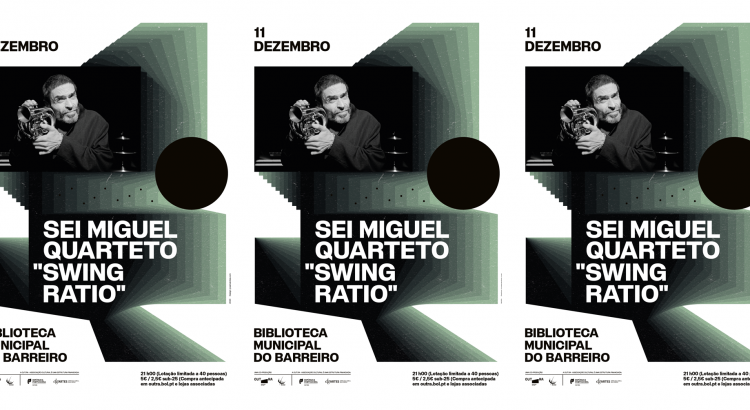
Sei Miguel Quartet – “Swing Ratio” at the Municipal Library

Our 2020 concert schedule continues, this time at the renewed auditorium of the Barreiro Municipal Library to host one of the great masters of genre-less music, trumpeter and composer Sei Miguel, who will present his latest work, "Swing Ratio", with his quartet.

This show will take place Friday the 11th of December at 21:00, and attendance is limited to 40 people, in accordance with the health norms in place. Tickets can be purchased here, or in person at Worten, Fnac or CTT stores.