Today we're very happy to announce our new and ambitious project to the world: PARTICULAR UNIVERSAL, which will take place in the magical Castro Marim municipality, in the most southeastern part of the country.
With financing by the Culture programme of the EEA* mechanism, and partners such as the Castro Marim municipality, the Norwegian NyMusikk and Lisbon associations Teatro do Vestido and Filho Único, we will develop several artistic co-creation activities related to themes of identity, memory and soundscape in the region, among which two dozen artistic residencies oriented towards the development of sound art and new music pieces by Portuguese, Norwegian and international creators, as well as the creation of a sound archive, a community archive for the "Voices of Memory", and the community production of theatre performances in dialogue with the municipality's inhabitants and immaterial heritage.
The project website is already online, and there we will soon announce several events and opportunities for artists across the world. Make sure to visit it and follow all the news related to this project through our usual channels.
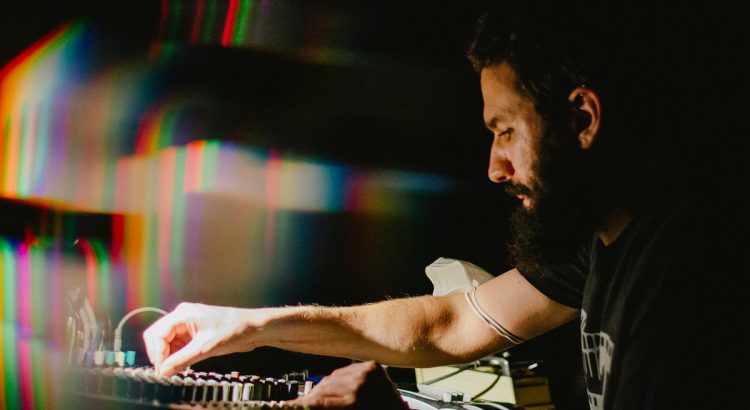
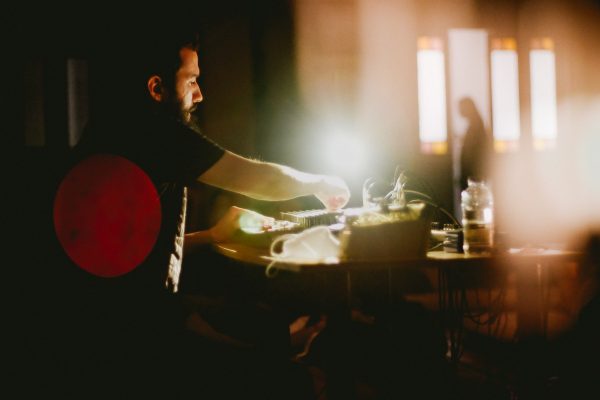
João Sarnadas, aka Coelho Radioactivo, was the man in charge of opening the last day of the second moment of OUT.FEST 2021, presenting a deep listening experience intimately connected to that of his debut work under his own name, the two double albums "The Hum" & "The Humm". At SDUB "Os Franceses" we were able to listen to two hours of electronic improvisation rich in harmony and texture in the perfect conditions for doing so: lying down, eyes closed, absorbing the sound.
We also had the chance to speak with the artist before and after the concert, and it is the compiled result of those interviews we present to you below.
What was your first contact with this kind of long-form, minimal music?
Hi hi. I always loved long music, not necessarily in terms of its duration but more of its composition, and the use of continuous sounds, for many reasons, including the fact that often there’s some sort of drama associated with long music like that and that drama is something I relate to easily. Thinking about it on the spot, I’d say my first contacts with long-form minimal music happened with artists who aren’t particularly “durational” or minimal, the first pieces I recall are “Back to Schinzo” by Pascal Comelade and “Stranger Intro” by Bill Frisell (the intro for a Marianne Faithfull album) which were songs I heard a lot when I was a kid. Pascal is one of my favourite musicians ever, and fortunately he has enough albums to be able to constantly hear new things from him, I only discovered his first, more experimental albums around 5 years ago. “Stranger Intro” is a 30 second loop that I heard on repeat, and I decided to make a version of it for this album, although when I made it I didn’t necessarily know it would become part of an album, I only wanted to try playing it in order to listen to what a version with more than 30 seconds could sound like, and it ended up turning into D1 M Bombarda Transmission. When it comes to more intellectual stuff, I think the first long-form minimal musician I got into was La Monte Young, then maybe Terry Riley’s concert with Don Cherry in Köln. But I don’t know if these were my inspiration to make this album, especially because this long form comes more from the way I play than from a prior decision to do so. Those are obviously musicians I enjoy, so they ended up influencing my melodies and my thoughts, but I think the music is always the result of a much wider range of influences.
Could you tell me a bit about the equipment you use on this album? It was built by Inês Castanheira, who runs a DIY synthesizer workshop. Was it a commission or was it given to you with the three oscilators?
Yes, the synthesizer I used on this album and the one I now use live is a simple one, with three oscillators and three on/off switches, made by Inês Castanheira. I’m fortunate enough to share not only my life but also my house with Inês, so I have easy access to the things she builds, and this one in particular is one of the first she built, because she was starting to explore synthesizer-building at the time, and that’s precisely the reason why it’s so simple. We started using this synth and another one in a project we both have called Well, and I eventually started using it in collective pieces by Favela Discos, such as the “Desilusão Óptica” piece. That was the background I had in developing the approach to the material I created for this album, based on the use of this synthesizer, the mixer, loops and other effects pedals.
You recorded this album in two days, which resulted in 8 hours of recordings, and it took you three years to mix it down to two albums of two hours each. What kind of methods did you use to bring it down to that size and what kind of challenges did you encounter in the cutting room?
Well, at the time when I did that recording session, I didn’t really have the idea of making an album out of it. As I said previously, I simply felt that I had arrived at a different way of playing from what I did as Coelho Radioactivo, for instance, and that I wanted to record something using that “language”. I actually feel like The Hum has something of Coelho Radioactive in it, I think that the melodies have something to do with that universe, as does the use of loops, which was something I did often both live and when playing by myself at home. At the time I had Nuno Loureiro’s mixer at my house, because I had used it at a Desilusão Óptica concert, and so I took the chance and started recording for two days, which as you mentioned resulted in 8 hours of music. It was actually more, around 11 hours, but I usually don’t count those hours because they weren’t that great to begin with. Basically, the biggest challenge was to understand the results I came up with, which led to two problems – first to reduce the music to a more acceptable length to make them understandable as “songs”, and second to figure out what those songs were, if they’d lead to three albums, to one, to two…which way to order them made sense…Eventually I managed to simplify it into two albums, one which was more “drone” and a more “ambient” one, or a more “atonal” and a more “melodic” one, a “daytime” album and a “nightime” album, but over those three years I started grouping the music with really quite different concepts, which probably aren’t that clear but which helped me understand what these songs were.
I read somewhere that you took cues from “the unique harmony of each city you lived in”, could you tell me a bit about that? Do you see any crossover between your music and architecture?
Well, in fact, even through it was inspired by things I feel about the record, the process, and my thoughts when I was making it, that’s a bit of press mumbo-jumbo. I’m always torn between conceptualizing the music I make or not, I usually don’t make things following a pre-defined concept, the only thing I’m interested when I’m recording is my intuition, and if I’m enjoying the music I’m creating. However, on the other hand, I’m interested in thinking about sound, and it’s something I do on my day-to-day for various reasons, either simply because of reading things about music and sound, or due to communicating about what I do solo or with the people I work with on a day to day basis – for instance, with the rest of the guys at Favela Discos when we develop collective pieces – we obviously need to speak about what we want to do, and either you want to conceptualize what you do or not you always end up having some thoughts about what you are doing. In that sense, something I’m interested in, for instance, is the relationship between ambiguity and deep listening. In the same way you can, with deep listening, discover melodies, rhythms, tones, etc in the soundscapes of a city, you can also discover new sound layers in the kind of music I make, in between the more obvious melodies you can discover other melodies, like you can distinguish them in the middle of the mass of sound and noise. In that sense, I think the relationship with the city soundscapes is that one, discovering some musical logic in the midst of the mass of sound we’re exposed to, between cars, fans and turbines, those noisy air conditioning things, and all the other things that make up the sound floor and which we sometimes don’t even notice.
The global phenomenon of ‘The Hum’, with tales of people who are almost chased by ultra-low frequencies in residential or industrial zones, is considered an unpleasant sound, one that leads to insomnia and headaches. Those are the last things I’d mention when describing your music. Does the album try to redeem this type of sound and put it in a different context, in a way?
Well, first of all thanks for the compliment. Regarding The Hum phenomenon, I think it’s unpleasant because it’s a sound that is an undesired and permanent intruder, but maybe that sound would be acceptable in an experimental music context (laughs). My idea isn’t so much to redeem the phenomenon, I simply think I adopted the name as a more encompassing term, like I said above, I think my The Hum is more about the sound of cities which isn’t immediately perceptible to us. This phenomenon isn’t audible to everyone, apparently some people are more susceptible to it than others. So, I wasn’t interested in talking about a violent, people-chasing sound, but simply about a sound which we only perceive when we become aware of its existence, or something like that. I’m interested in the idea, but not so much in the text-book definition of the concept, and like the music, one of the main reasons I chose the name was due to my intuition, I liked the mystic aspect of the idea and it looked like a cool name. Besides, I also used this theme and title for a comic book released by O Panda Gordo in 2016 or 2017, and at the time I thought it would be cool to connect the two things because they work on the same idea in very different ways.
How different is the album and the music when you play it live? Did you make any adjustments for the OUT.FEST concert?
Well, I’m not actually playing the music on the album, what I’m doing is using the same means and techniques to create new music. The album was created through improvisation, which is what I do live, although lately I’ve been bringing along some pre-recorded loops so it isn’t as boring. During rehearsals I tried to replicate some of the music on the album, but I wasn’t a fan of the result, since I was concerned with make the music sound like the album it ended up sounding like a cheap copy of it, which both wasn’t identical to it or as interesting as it. So I thought the best thing to do was to simply use the techniques I used on the album to create something new, which isn’t what’s on the record but is a part of it, in a way. For OUT.FEST, the only special thing I did was to select some pre-recorded loops, but the concert preparation was all very chaotic because it was the first time I used the scenography and it was all a bit last minute. I think the biggest adjustment I made for this concert was to use the “city” prop, or whatever you want to call it, which was something I wanted to do since the beginning but hadn’t had a chance to, and I was very happy with the result.
It's been almost two months, and we're now totally focused on OUT.FEST 2022 - the 18th edition of the festival, which is thus nearly coming of age - but this week we've released a mini-documentary which recaps the events of the second half of 2021's edition of OUT.FEST, which took place in October.
Created by Mário Jerónimo Negrão from interviews, video and sound gathered by the OUT.FEST team with the help of many collaborators and friends (for which we are thankful), it serves as a way to celebrate and remember six days of intensive listening, of long awaited reunions, and new and long-lasting discoveries.
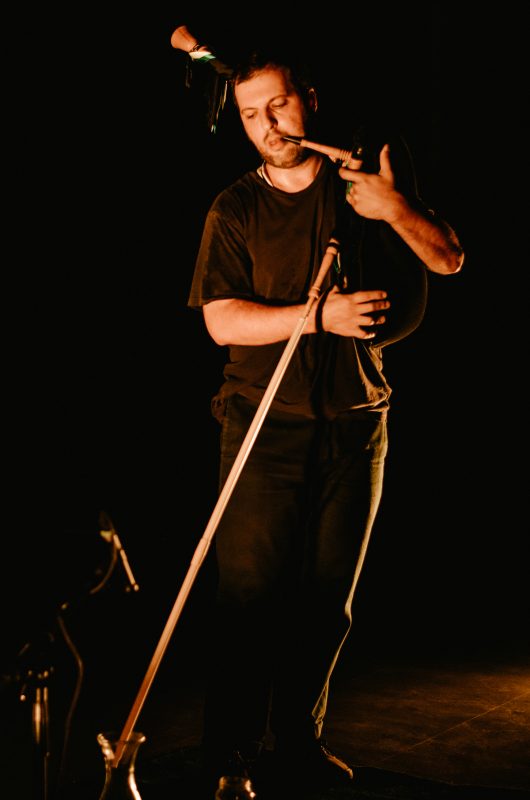
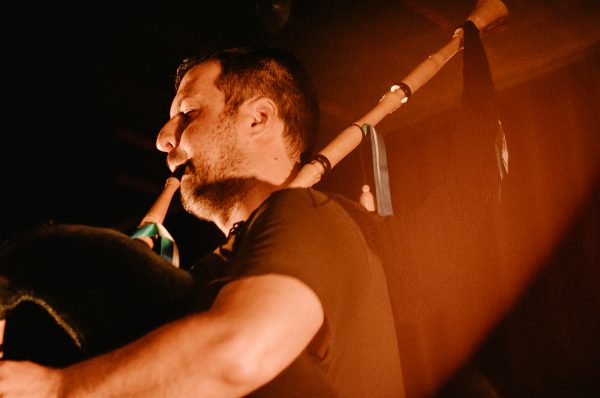
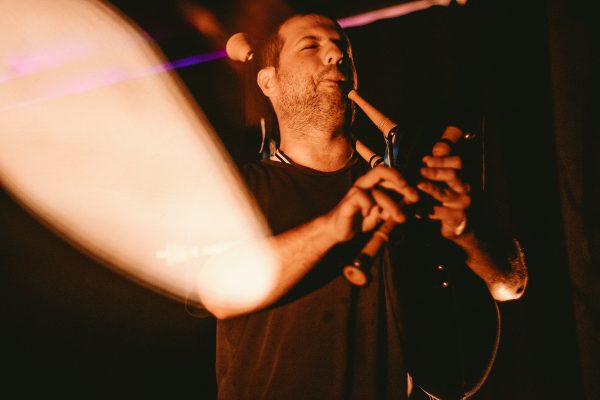
In the week prior to the start of the October moment of OUT.FEST 2021, we had the chance to talk to Vasco Alves - bagpiper for 'Os Belenenses' football club, member of VA AA LR and heroic investigator of acoustical phenomena and the materiality of sound, whose trajectory's been discreet but continuously fascinating, resorting to numerous sound sources and methodologies including synthesis and amplification techniques, tape recorders, signal processing and – more recently – bagpipes.
Can you tell me a bit about your experience with the bagpipes? How did you start playing them and how did your relationship with the instrument develop over time?
I started learning the bagpipes in 2014, at the Lisbon Galician Centre, and during the first years I had a traditional learning experience, but I always wanted to use the instrument in a less conventional, more exploratory way, closer to the themes I’m interested in, and that’s something I was only able to do a few years after I started playing the bagpipes. I think it was about three years ago, maybe in 2018, I started preparing a few pieces which, although they also include some electronic material, work on acoustic phenomena and psychoacoustics above all. I always try to explore some kind of effect within that field.
And what drove you to this instrument specifically? Because in 2014 you were already active in making music, right?
Yes, I had been playing for quite some time by then...I had two experiences which were somewhat surprising, so much so that when they occurred I didn’t even imagine I’d be learning an instrument one day. One was a concert by Paul Dunmall in London - he’s more associated with jazz and even improv as a saxophone player, but he has a personal collection of bagpipes from around the world. Me and a friend invited him to play at a concert we were organizing when I lived there, and he did a performance where he played with several bagpipes throughout, and there were some amazing moments in there that I wasn’t expecting, even in terms of the sound material...when the bagpipes were amplified, if you closed your eyes you could imagine it was a laptop concert, a computer music concert...well, there were some really surprising elements, and then when I returned to Portugal in 2014, I ended up attending one or two concerts where the instrument was also used, although outside this context, but then I decided to learn it, in a somewhat spontaneous way. And that was it, I liked it and kept doing it and at this point it’s possibly the instrument I work with the most, even though I also explore similar themes when I work with electronics.
On that topic, when did you become interested in electroacoustic music? Was there a specific moment when you discovered that kind of music and thought that was what you wanted to explore?
I don’t know if I can name a specific moment, I think that it’s probably related to the music I heard during my adolescence, which led me to have some interest in exploring, in following the more exploratory path in music, the less conventional one, so to speak. And in my university years, if I’m not mistaken, I learned how to make some contact microphones and some other small things (I think my first recordings were with that material actually, even if they were done in a very naïve and intuitive way), and well, things evolved from there, I kept being interested in instrument building, in exploring materials…Obviously, the things I’m interested in nowadays aren’t necessarily the ones I was interested in at the time, but it’s been evolving, going through several phases, although I think there’s something that unites them.
So what was the music you heard as a teenager that led you in that direction?
Well…in my early teens I listened to a lot of Sonic Youth (and all the musical scene they were a part of), that’s possibly one of the first times I saw instruments being used in a less conventional way. And going back to your previous question, there was actually a moment when I discovered Christian Marclay’s work, I saw one of his exhibits as well as some concerts and tapes, and I think that moment marked me somehow, also because of the way he used the materials and the sound that was generated by the things he built, the processes he explored and which were part of his pieces, all of those were very influential to me at the time. Soon after I discovered the great master, Alvin Lucier. There are many other things which have influenced me since, like the work of Rafael Toral, and Sei Miguel…But well, it becomes difficult to name specific influences, since I’ve been influenced by so many things.
The relationship I see between all of those musicians is in part related to what Eddie Prévost says and tries to teach others, which is to see an instrument as something to play “outside the box”, that you should be something of an explorer and improviser with instruments. On your website I saw the radio you played, and it looked familiar – were you at Eddie Prévost’s workshop [at OUT.FEST 2015]?
Yeah, I also used to take that radio to the workshops he organized in London, which were a weekly improvisation meet-up, every Friday night in a church basement, where everyone could show up and join, and for about two years I went there regularly, so that’s why I also participated in the Barreiro workshop that OUT.RA organized.
And what did you learn from those workshops? How did they help you develop your work?
I think those workshops had quite the impact on me at the time, but nowadays I don’t feel as close to or interested in free improvisation, which is basically what Eddie Prévost is focused on. Those workshops were an amazing thing for me at the time, both on a personal and social level, there was a dynamic which to me was new and quite exciting, the way the workshops took place and how people played there… there were small rules, but there was a lot of openness and fluidity and no-one ever told you what you should or should not do, and that fascinated me for a while. Meanwhile I think it lost a bit of…I don’t know if I became less naïve about that idea, or if I simply became more interested in other ways, other things…but I also experienced some incredible moments, there, with really great musicians, and I think that at a certain point, towards the end of the time I participated in those workshops, I would go there more to watch one or two people (like Seymour Wright) whose work I was interested in and fascinated by, and the five or ten minutes I’d hear them play would make the hours I’d spend there worth it…
You were saying that your interests started to change – can you tell me which part of music interests you the most right now?
Well, about free improvisation: I think that’s not the core of what I’m interested in nowadays. My work, be it electronic or acoustic, always involved a lot of volatility and so improvisation is still very important to me, but I like to work on themes, be them things that came from working with an instrument (in the wider sense), from the “life” that volatility and instability can generate, but also spatial themes, of the connection between the instrument and the space, and trying to somehow find a way to create work which fits in this context. Improvisation is obviously always present, because I have structures but I don’t define what I do exactly, there’s space for me to react to things in the way that seems the most appropriate in the moment. The bagpipes themselves, being such a rough, primitive instrument in a way, and maybe the instrument’s limitations themselves, I think they’re a good way to explore this kind of ideas, because in a way I feel like that simplicity and rawness then allow others parts to come to the fore, to have some importance, be heard and perceptible, and the bagpipes end up being the trigger for those events, in a sense… trigger para esses eventos….
That brings me to another question – I notice that in your music, especially your most recent work, there’s a certain duality, between folklore, some very primordial stuff, and a more technologic and machine-like angle. I don’t know if that’s something you agree with…
It’s certainly not intentional. The tools I use often tend to define what I do. The bagpipes fell into my lap so to speak, like other things I’ve been using, and my perspective has been more like: “What can I do with this instrument, what does it give me, how can I apply it to what I’m interested in doing sonically?” In the concert I’ll be presenting at OUT.FEST, the computer is simply generating a frequency, a sawtooth wave, which has a very similar sound to the bagpipes, it ends up being almost like a second player, which then generates this clash of frequencies…It’s a bit hard to define, but like I mentioned I’m interested in exploring instabilities in the processes and mechanisms I build, and I try to do it with the bagpipes as well. But like I said it’s not a conscious decision, I like to work with rawness, I’m interested in a certain dryness in things and materials, and I move towards musical construction from there, to develop the work I do, but in fact, to me these are all things that fit mentally in the same place: to use the bagpipes or a synthesizer or a circuit I built or a radio, the ends to me are the same, there is no concept behind that.
You use the instruments because you really like their sound…
Yes, and because I’m interested in the rawness and brutality of things like white noise, or the sound of the bagpipes, which is also quite simple, in the simplicity in working with electronics, I’m really fond of all this…let’s say that the notion of economy, of doing a lot with meagre means is something I’m really interested in and that I strive for in the processes and things I create.
I wanted to ask you about the work you’ll be presenting at OUT.FEST, “Gaita Contra Computador” (“Pipes vs Computer”). The title calls to mind the idea of opposition, of combat, almost…You mentioned there’s a computer tone that’s really close to that of the bagpipes, can you tell us a bit more about that work of yours?
“Gaita Contra Computador” is the title of a CD I released last year, and yes, the work is based on the creation of a few pieces which are relatively short, some of which influenced the name of the album and which involve the bagpipes used without amplification in a space, while the computer is generating a frequency I programmed which generates tones that are very similar to those of the bagpipes, and the idea is that when frequencies cross in the space they create a some acoustic effects (like pulses, for instance)…My intention is to give listeners an impression that there’s a new sound emerging at a certain point, an union between the two sounds where eventually you stop being able to distinguish one from the other…but overall I’m interested in knowing how sounds cross in the space, it’s like I have another person playing with me there, but when you explore frequencies which are very, very close and you move around in the space there are small effects that come to being, in the acoustic space in this case, the concert venue.
Then I might present some acoustic pieces as well, without the computer, where I explore the bagpipes and their physical limits, I try to pull the pick to sound registers which aren’t exactly the ones the instrument is meant to reach, looking for flaws and exploring those flaws and that instability. Then there’s another piece which involves adding a tube to the bagpipes and pointing that frequency to a few jars on the ground, and explore the jars’ resonating frequency – when you bring the sound of the bagpipes closed to the jars a new frequency emerges, and it’s a piece focused on that interaction…and my concert will explore these ideas – they are pieces which somewhat resemble what’s going on in the record but which are in constant evolution, every time I present or rehearse them they are adjusted and mutate over time.
And the space itself influences the way the pieces sound like – I remember, for instance, having had Erwan Keravec play in Barreiro, and he was very happy with the natural reverberation and amplification of the church he played in…How has your experience been like in playing in different spaces, do you also feel like it has had a big impact in the way you play?
Of course, it always does, not only in acoustic pieces but also in the ones I use the computer in…the resonance of the space tends to make the pieces sound a bit better, I think, they might not work as well in a very dry space…I could be forced to think of something else, but yes, the acoustics of the space are really important, it’s something I always have to keep in mind every time I play, and in this case I’ve already been to the library [the Municipal Library of Barreiro, where the show took place], to check it out and try playing there, and that ends up influencing what I’ll present somewhat…
You were telling us how you’re really interested in intensity a while back. I wanted to ask you about “Estrada Longa” [Long Road] – I was listening to it a few days ago and felt that it had something close to motorik, not so much in the rhythmic sense of krautrock, but as a certain propulsion and trance, not in an intense way, but conveying motion, and the bike ride…Which is what inspired “Estrada Longa”, your trip on the N2 on a bike in the middle of the pandemic, right? Can you tell us a little about your trip, and how that influenced the record?
Yeah, that was it. I made the trip on my own on a bicycle, and at the time I hadn’t planned to make anything out of it, I simply started riding and seeing tonnes of place names that I liked, and so I decided on the first day to start recording the names of the places I passed through. Almost all of them, although I didn’t do it constantly – first I’d pass through a few, record it on my phone, then I’d go a little further and record some more, and by the end of the trip I had almost 150 place names recorded, from Trás-os-Montes to the Algarve.
Then I spent some time thinking about how to use that material. Those were phone recordings, and often I was pedalling as I recorded, so even though I thought they were interesting I couldn’t quite get them to fit, and so I concluded that the raw material wouldn’t be as interesting (even though I find that aspect interesting as well). What I ended up doing was to grab a pair of synthesizers I had at home and which I use often and which basically allow you to create a sort of patterns with a lot of instability and volatility due to the way they are connected, there’s a cyclical aspect to it, but non-linear in a fashion, and I thought that the two things could be joined, so I created other patterns, one for each day of my trip, and I re-recorded the names of the places I passed through each day.
And that’s how the record came to be – as you mentioned, there’s that cyclical aspect of the synthesizer, and I wanted to get a sense of monotony across as well, I was interested in that idea of long days, of never-ending but constantly mutating roads…that’s how the pieces emerged and they had that final result, the album. I’m not sure if it makes sense to follow up with it, I think that work ended there, with that piece, which sometimes I think could have been longer: instead of 50 minutes it should be four hours long, but that’s how it ended up like…
The last question might be a bit of a silly one, but: how did you become the piper for Belenenses [a football club based in Belém, Lisbon]?
(laughs) My connection with Belenenses comes from my family, my grandfather and great-grandfather were from Belém, I’m a supporter since I was born, etc…The club was recently relegated to the last division, because of the conflicts with B-SAD, and the first time they played after that I decided to take the pipes with me. I had already spoken with some friends who were connected to the supporter group, and I started playing the club’s anthem, everyone started singing in the stadium, and at the end of the day there were already videos on YouTube connecting that moment with an old tradition of the twenties, the Belenenses’ fifteen minutes – supposedly the club made a series of comebacks in really important games that year, including a famous one against Benfica. And so for many years the supporters would make a lot of noise in the last fifteen minutes, I heard that with whistles and pans, and someone connected my playing to that tradition, so now during games, in the last 15 minutes, I play the anthem and some other supporter group (the Fúria Azul) songs, and it became something regular in the games. Now I feel that I have this responsibility, so every Sunday I’m at the stadium with the bagpipes, there’s two of us playing them right now actually…so yeah, that’s where the bagpipes-Belenenses connection came from.
That’s really cool. You weren’t aware of that tradition yourself, were you?
I did, my grandfather told me as a child, but it wasn’t with the bagpipe you know, he just said that they used to make a lot of noise in the stands, or they’d play a whistle three times, but meanwhile that completely died out, there’s even books in the 60s of people connected to the club who mention that players didn’t know what the Belenenses’ fifteen minutes were anymore…and that was in the 60s, in the 90s I’d still hear a few whistles, but it was practically forgotten, and now it has some meaning again, it’s funny.
Interview by Tiago Franco and Diogo Carneiro. Pictures by Pedro Roque (the first one) and Nuno Bernardo (the remaining).
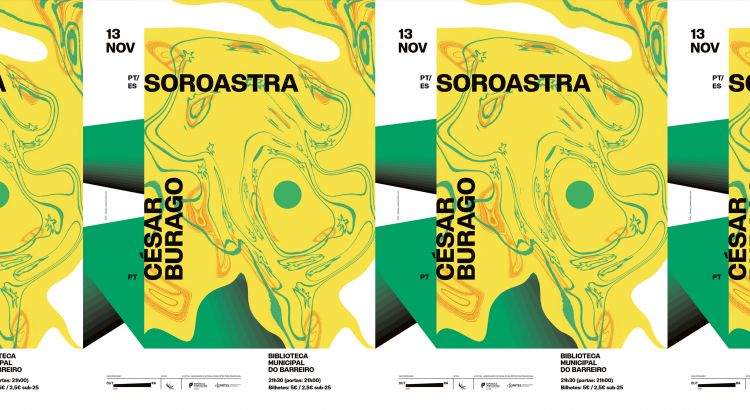
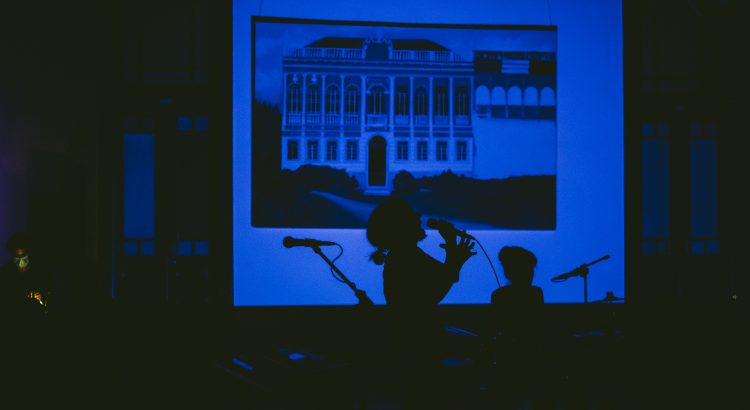
After a long and intense OUT.FEST, we're back to our regular programming with brand new cosmic music from the Soroastra duo (made up of Afonso Simões and Spain's Borja Caro), in one of the first presentations of their wonderful new album "Olimpíadas de Pensamentos Acelerados", as well as the always unique César Burago in a solo presentation armed with small percussive instruments, finally returning to Barreiro after his originally planned show in the spring of 2020 had to be cancelled.
These concerts will take place in the Auditorium of the Barreiro Municipal Library on Saturday, November 13th, starting at 21:30. Tickets, priced at the usual 5€ (2.5 for under 25 yrs old) can already be purchased via outra.bol.pt
After analysing the numerous and generally outstanding applications we’ve received to the 2021 OUT.RA Creation Grant, this year we have decided to select two projects as recipients of this grant:
André Neves (also known as George Silver), a Barreiro musician with a growing reputation for his artistic work, will work on a new album (his second LP) which will feature a diverse cast of guests.
Vera Marques (aka Puçanga), a multidisciplinary artist resident in Seixal (one of the neighbouring municipalities recently included in the scope of the Grant), will develop a “vocalgraphic” investigative and creation project by bringing together several vocal circles, a work which will also be released as an album.
This annual grant has been awarded since 2016 to musicians and audiovisual artists residing in Barreiro and the surrounding urban areas in order to create and present original works. This year, each of the selected projects will be supported with 1000€ in order to achieve its aims and host at least one public presentation of the work developed.
Throughout the following months we'll be revealing more details regarding the selected projects and their journey towards completion.
While waiting for our chance to once again bring live shows to Barreiro, we've been actively working behind the scenes to bring you some exciting news we've been eager to share with you. One of them is the latest release by AMM, the legendary British free improvisation outfit, whose 2015 concert at the Baía do Tejo Industrial Museum, part of that year's edition of OUT.FEST, has now been released by the Matchless label, itself a key institution in understanding the history of improvised music throughout the world.
"INDÚSTRIA", ("Industry") a name chosen by percussionist Edwin Prevost in tribute to the history behind the building where the concert took place, is now available at Matchless' website. This release has been enriched by photos by Vera Marmelo and several texts, one of them written by OUT.FEST co-director Rui Pedro Dâmaso.
Don't miss out on this chance to grab a piece of the history of AMM, improvised music, and, of course, Barreiro.
Concert series Kontraklang – REMAIIN’s Berlin partner organization – focuses on the film music of composer Teiji Ito for its first activity as part of the project. A lecture performance/film titled "The Cosmic Music of Teiji Ito", created by Michiko Ogawa and Manuel Pessoa de Lima, will be published online on March 15.
The groundbreaking experimental films of Maya Deren and Marie Menken rightly enjoy cult status among connoisseurs. The music of these films, on the other hand, is largely unknown, despite being an essential componen. Originally planned as a live concert in which Teiji Ito's works would be performed for the first time in Berlin along with the screening of the films, Michiko Ogawa and Manuel Pessoa de Lima are now realizing their lecture performance as a video work that will be accessible online free of charge. In it, the two artists interweave aspects of Ito's, Deren's and Menken's work with biographical details, absurd background information on the creation of the films and music, as well as their influence on experimental art in the mid-20th century to create an associative collage.
The main points of reference are four films and their soundtracks by Teiji Ito: Meshes of the Afternoon and The Very Eye of Night by Maya Deren, as well as Dwightiana and Bagatelle for Willard Maas by Marie Menken. Ito originally conceived the music as "aural scores": he recorded all the instruments himself on tape, one after the other, and then superimposed the recordings to create the finished piece, rather than notating the music and having an ensemble play it. The composer drew musical influences from a variety of genres, practices and styles, including Japanese gagaku, flamenco guitar, Andean folk music and Western classical music. The soundtracks were transcribed by ear as part of Michiko Ogawa's research, making them accessible for further artistic exploration for the first time.
The film "The Cosmic Music of Teiji Ito" is expected to be released via Kontraklang's website and social media channels on March 15, 2021, and will then be available online free of charge.
The film "The Cosmic Music of Teiji Ito" is expected to be released via Kontraklang's website and social media channels on March 15, 2021, and will then be available online free of charge.
Erwan Keravec is a Breton piper whose eclectic path ranges from traditional to contemporary music and improvisation. This encompasses playing solo music written for him by a wealth of contemporary composers, leading a piper quartet, improvising with key figures of european jazz and writing and playing music for modern dance and theatre companies. He performed at the Nossa Senhora do Rosário church in Barreiro on July 2019, and after his soundcheck he took the chance to interview him. You can read that interview below.
Hi Erwan, can you tell us more about your background as a musician and how you chose the bagpipes as “your” instrument?
I grew up with traditional music. My parents were dancers in the traditional Brittany style, with traditional music from Brittany, and when I was a child the first instruments I heard were the bagpipes and the bombarde, a kind of oboe. I learned to play the bagpipes in their traditional context for marching and dance. One time I played with an orchestra in Bern with bagpipes, snare drums and the bombarde and we met a jazz big band. That was when I improvised with the bagpipes for the first time, and after that I decided to focus on improvised music, even though my background is really in traditional music.
Have you tried other instruments in the bagpipe family, from other musical traditions? How would you compare them to your own?
Two years ago I played in a trio with three bagpipes: one from Algeria, another from Iran and mine, from Brittany. And my idea at first was that the three bagpipers would play solos, and when we were practicing of course we tried each other’s bagpipes, and it wasn’t very easy (laughs). It’s not the same fingering, of course the system of breathing is the same, but the fingering is totally different, so it’s not very easy to play other kinds of bagpipe…I focus on the one from Brittany exclusively.
You’ve been touring with your ‘Revolutionary Birds’ trio (with Wassim Halal and Mounir Troudi). How did this collaboration come about?
Revolutionary Birds began as a commission by two festivals, one in Beirut, Irtijal, and another in Paris, la Voix est Libre, and the idea the two directors had was to mix music from Iran, Lebanon, Tunisia and Brittany. It was not our idea at first, but after that the three of us decided to take this idea and to tour with it. For me this is different from what I usually do - when I play solo, in duo, trio, etc, it’s always my idea, but this was the first time I played in someone else’s idea. At the beginning I was like “ok, what kind of band is this”! We work a lot with percussion right from the start of the composition, so the structure of our music is all based on the bagpipe and the percussion and the voices come after. But it’s not what I usually do - usually I take an idea from beginning to end, so this is different for me.
How have the trios’ performances been received so far? Have you been getting good receptions by the audiences?
Yeah yeah, in all kinds of different contexts, even in rock music festivals. We don’t really play rock music but it’s not world music either…I don’t play music from Brittany, I just play the bagpipes from Brittany, and the singer, Mounir, doesn’t really sing Tunisian music either. He does some Mawwal, which is improvised music from Tunisia, but it’s not a song, it’s an improvisation. So, in traditional and world music festivals, the reception is good and in new music festivals, it’s the same, so…it’s strange. (laughs)
Today you’re bringing us your “Urban Pipes” performance – can you take us through the idea behind it, its guiding principles and aims?
At the beginning, in 2007, the project was only for recording, and at the time I didn’t want to play this music in concert, I just wanted to record. Being a solo bagpipe player is the traditional way to play the instrument, and when I decided to do this it was because I wanted to make new music on the bagpipes. So, I took the traditional form of this instrument, the solo bagpipe, and two years after when I started to play concerts, I decided to play just one piece and move around a lot, change a lot… After my second record I had changed a lot and kept composing and…”Urban Pipes” is…my conception of what bagpipe music is, what I can do with them.
When I decided to do this, I wanted to make music without any reference to traditional music. Is it possible for the bagpipe to be just an instrument on its own, not an instrument exclusively used in traditional music? What can new music for this instrument be like? That’s what I was after, but it wasn’t that easy because I grew up in that same tradition, so my ability to imagine music is of course influenced by traditional music. It’s really different now because I work a lot in new music, in contemporary music, so I can think about music differently now, but in 2007 it was really different… the traditional music in Brittany is the music of the countryside, not of the city, and when I decided to create this new music I tried to see what could be urban music for bagpipes.
Have you performed in churches before?
Yes.
Did you enjoy the experience?
Yes, of course!
Why is that?
Because the sound is really loud, there is a lot of reverberation. The sound can be everywhere, so it’s possible to have it come from the front, from the back, and churches are really wonderful for that, of course. And the sound is loud, I don’t really like to play outside because there are no walls there, there is no reflection, and in a church, reflections are everywhere, so… I love playing in churches.
How do you feel about this church and its acoustics?
It will be loud (laughs)…it will be loud. But that’s good! (laughs)
OUT.RA – Associação Cultural is now accepting applications to its creation grant by young local artists who want to develop artistic work related to music / sound / sound art / multimedia during 2021. This time, we've decided to expand the geographical range of potential applicants by allowing residents in the neighbouring Moita and Seixal municipalities to apply for this grant, set at 1000€.
Since 2015, the OUT.RA Local Creation Grant has supported artists like Tiago Sousa, Van Ayres and Camila Vale.
You can read all the necessary information regarding this grant below. Applications are open until January 31st 2021. We're looking forward to receiving your projects!
OPEN CALL
OUT.RA LOCAL CREATION GRANT 2021
The criteria considered in selecting a project for this grant are as follows:
Resident in the Barreiro, Moita or Seixal Municipalities;
Age between 18 and 35 years old;
Education (higher or technical) in artistic fields, particularly in Music / Sound Art / Multimedia / Ethnomusicology, or alternatively relevant work already developed in Music / Sound Art which reveals an interest in seeking new solutions and an idiosyncratic artistic personality;
Awareness of the work developed by OUT.RA (OUT.FEST, regular programming, sound documentation, etc) and degree of project fit with said work;
Conceptual quality of the creative project, level of maturity presented in regards to its development, feasibility of the presentation in terms of means necessary towards realizing them.
The work developed by the recipient of the grant should take place between April and December 2020, and have at least one public presentation as part of its outputs.
This grant is set at 1000€.
Applications should be sent to info@outra.pt up until January 31st and contain the following information:
Name, CV and artistic biography;
Project description and calendarization.
Materials necessary for the development of the project.
Clothilde é o alter-ego musical de Sofia Mestre, colorista, fotógrafa, desenhadora e não só, que se encontrou enquanto música na viragem para os 40. Trabalha a partir da herança de pós-minimalistas, improvisadoras e compositoras de mente aberta, como Pauline Oliveros, Maryanne Amacher, Daphne Oram, Eliane Radigue ou Delia Derbyshire, para criar a partir de bases electrónicas modulares – tecnologia feita pelo seu companheiro Zé, aka HOBO -, novas paisagens e realidades emocionais e estéticas. Em Outubro de 2018, durante a edição do OUT.FEST desse ano, onde testemunhamos uma bela actuação da artista na Escola de Jazz do Barreiro, o Alexandre Ribeiro e o Vasco Completo tiveram a oportunidade de ter uma curta conversa com os dois – Clothilde e HOBO – sobre o sistema electrónico único que usam e as suas origens, bem como o despertar de Clothilde para a criação músical.
When did you start building this kind of machines?
HOBO: I started thinking about this some six, seven years ago. At the time I was building some machines in cardboard (I always used the materials I had close by to build things) and one of the times I went searching for materials I went to my father’s house, who did radio assembly in Guinea-Bissau during the colonial war, and he had a breadboard and some chips along with some other stuff that he told me to take. I put them in my bag and then it was stored in a drawer for about a year, until I stumbled upon something that reminded me that I had that stuff at home. Then I started building things, first an amplifier in a Scotch-Brite box, very basic stuff, and it grew from there. I started thinking, “Ok, I want to send the sound somewhere, so I need an amplifier.” That was step number one. Number two: we need some oscillators, let’s do it. From there it kept growing, I kept researching, seeing what had been done before and what I could do differently. Nowadays with the internet you can take giant steps with these things – before it was much more complicated, all the information was only in books, but now you make a quick search and you get the gist of what you need to do, and once you learn what’s already been done you take a step back, explore the chip’s technical specifications, and use that knowledge to create your own things. That’s what the process has mostly been like, self-taught and unpretentious, doing it because I enjoy it.
About the specific machines the “machinist” uses, can you take us through how they work?
CLOTHILDE: There’s several of them…
HOBO: We didn’t bring all of them with us…there’s around ten over there, plus some keyboards, and in total we probably have around 20…the idea is that each of these machines should be able to be used independently and make sound on its own, kind of like a modular system but not entirely, because in modular systems you have to carry everything with you, but here if I want to just take one machine I do that and output its signal directly through a jack, or I can use a banana jack to send its sound somewhere else. I wanted it to be very versatile, so that I could play with one, or two, or all of the machines….
C: It’s interesting that it’s only now that we can play together – before we didn’t have enough gear to play at the same time. That’s a big part of why I play by myself – he’s got a project with a friend where he also uses these machines and if we both played at the same time we’d limit each other, because in order to make certain sounds you need these boxes to be connected, for modulating, filtering, whatever. Now we can though, and the next step is also to start a project and play together.
How did your activity as a musician begin?
C: I’ve always been crazy about music, but I never had the desire to make music, it was proposed to me, because people knew I played with him, and so it happened. We have a house in Meco with friends, for resting, and he [HOBO] would take his machines and we’d play around with them, but I never harboured any ambition of playing in concert one day…
I’ve been friends with Sonja from Labareda, the label I released my album on, for many many years now and she knows me very well – better than myself apparently – and so she challenged me to make something and I was like “You’re crazy…me?”. It wasn’t something I ever even wanted to do before, but I ended up thinking that I couldn’t spend my whole life considering it so…
You’ve recently released your first LP, “Twitcher”…does your career have anything to do with music?
C: Nothing.
Can you tell us a little about that?
C: I’ve always been a fanatic about music, ever since I was little – to the point where I’d start crying if my mother put something on that I didn’t like. It’s true! But I never worked in music.
My grandfather was the drummer for a great jazz band in the twenties, my mother made a tremendous effort to push me towards studying music (she wanted to study it when she was younger but my grandfather wouldn’t let her because she was a girl), my uncle plays everything…so music was always there.
I worked in advertising and cinema for many years, I’ve been a colorist, I like drawing, photographing, now I’m setting up a project with a few friends and we’re still figuring out what’ll come out of that…But this…I made “Birdwatching”, which was what Sonja challenged me for, a compilation, and that’s when I told her “well…I’ll do my best, I promise I won’t let you down, even if it kills me…”, because I’m a little demanding with myself, a little too much so even. Then she started talking about an album, and that made me go “so it’s not just a song anymore, huh?” but I had already passed the first hurdle, I had my first concert at Damas…then I played the second at Lounge, the third at Walk&Talk in the Azores, then at ZDB, by then I was even saying “well damn, there’s only Maria Matos left” (laughs). I don’t know what happened, I wasn’t expecting it, but I know I have an ear for music, I know everything’s here. I don’t count the measures, I feel them, it’s a lifetime of listening to music with a lot of passion reflected here. I made the album (the release party was on May 25th) and strangely it came out well. I was very happy, I didn’t know what was going to come out…
How has it been received so far?
C: It’s been insane, I don’t have the time to be an artist… (laughs) Just last month I had three concerts, at Festival Exquisito on the 13th, at WOS in Santiago de Compostela on the 15th, then in Porto in Passos Manuel on the 22nd, in a night organized by Fungo where Zé [HOBO] played with Marco (o Citizen:Kane), because we couldn’t play together, plus Nuno Patrício and Nicolai, the Fungo DJs, we all played and now I’m here. And meanwhile I have several proposals to answer…even as far as 2020, and I get really nervous with those things, I don’t even know if I’ll be alive then (laughs). But it’s a super interesting project and I think it’s totally my thing, because it’s a theatre play.
Part of the impressive mina collective, participant in the Rabbit Hole parties and, for some time now, member of Rádio Quântica, Viegas is a Barreiro-born artist and DJ who was a part of OUT.FEST 2019's closing night at the A4 space. Before the festival we had the chance to speak with him about his artistic path and his activity in the collectives he is a part of in an interview you can read below.
How and when did you discover techno and electronic club music?
In 2014 I spent a few months outside Portugal, in Barcelona, and my way of getting to know the city and its people was by going out at night. Burial’s River Dealer had recently been released at the time and that ep was also a gateway to electronic music for me, especially for the musical scene in the UK, but to other things as well.
What kind of clubs and nights out did you usually go to, after that formative period? Usually here in Barreiro and in Lisbon I suppose?
In Barreiro my nights out were usually in the streets…but in Lisbon I’d go to Lux, as well as some Rabbit Hole parties and Príncipe nights.
Before we talk about your collective, I wanted to ask you about the Rabbit Hole nights, as they were parties which despite being associated with dance music were very eclectic, I even saw a friend of mine who plays drone music perform at one. Do you feel as if that mix of different music genres influenced your way of being a DJ?
In a way yes. At Rabbit Hole there was a place for all kinds of artistic expression, everything could be a part of one of those nights. That eclecticism in programming might have influenced me, yeah. Growing up in the suburbs also had a large impact in my way of looking at electronic music and in my interests. I grew up listening to Kuduro and Kizomba well before Techno or House or any other style…so lately my work has been in figuring out how to mix the many reference points I have into something appropriate for the moment when I’m playing.
Moving on to mina, how did it come to be and how did you join it?
Mina started after Rabbit Hole and Rádio Quântica (another project that I joined a little while after I started working with Rabbit Hole) joined forces. At the time Lisbon lacked an electronic music night that provided a space for people to experiment with their identity and sexuality…where rules were…implied and based more on mutual respect than those rules usually associated with more institutionalized spaces. Pedro Marum, one of Rabbit Hole’s founders who also joined Rádio Quântica around the same time I did, had the idea to start these mina nights with Violet and Photonz, the founders of Rádio Quântica, and since I was working with both projects I was invited to help out.
Speaking of Rádio Quântica, do you still have the “Mercúrio” radio show?
Well I’ve since changed the name to rave3000, and lately I haven’t done the show as often, but yeah.
How different are the playlists you make for radio shows and the ones you play on the dance floor? What are the differences and similarities, and what do you try to bring to one and the other?
Maybe I’ll start with the similarities: it all comes from the same place, I have similar criteria for both and I try to be inclusive and always focus it away from the centre. I don’t have as many concerns with the show, if the music is danceable or how it’ll be received, so I think it’s a much more experimental space with much less expectation from listeners. I always try to share the slot with other people as well, so it changes depending on whom I invite. On the radio, to me, the most important thing is to give other people a chance to access the platform, and I’m sure that if Rádio Quântica didn’t exist things would have been much harder for me.
You’ve played outside Portugal several times, in Berlin for instance…
Yeah…this last year I had the chance to play in several European capitals, like London, Paris, Athens…
Those are quite different cities, and known for their night life…how do you think Lisbon compares to those places? Is there anything unique about the city in that sense?
I feel more comfortable in Lisbon, so I am freer to experiment with some things. Usually I play in contexts where audiences are used to hearing all sorts of music and where that diversity is celebrated. Maybe this convergence is more normal because we don’t have as big a variety of nights dedicated to specific genres. In London, for instance, I felt the same, but in the UK there’s a very rich and diverse history of electronic music. I’m not sure if it’s unique, but since it’s a smaller city it’s easier to meet people from different scenes.
You studied documentary cinema, correct?
I started out studying Advertising and Marketing at the Escola Superior de Comunicação Social, but I quickly realized that wasn’t what I wanted to do, so I went on a one year Documentary Cinema course and studied Photography at Ar.Co and at the Fine Arts faculty.
I know you photograph the mina and Rabbit Hole nights. Do you feel that some of your education influenced your work? Not just as a photographer, but as a DJ as well?
I think it was the other way around, it was clubbing that ended up influencing my work in photography. My interest in photography arose from going on nights out because I felt the urge to create a record of what was happening. Now, I don’t know, in the future I’d love to explore the visual component of my shows more, so maybe it will change and photography will start influencing my way of DJing.
Coming back to Barreiro – You were born and grew up there, and according to one of your posts you would hear the festival from your bedroom. Can you tell me about your OUT.FEST experiences, starting from that moment in your bedroom?
I was living close to Ferroviários at the time, and the festival happened there several times. So I remember being younger and being unable to classify the kind of music I was listening to, and that was always interesting to me. When I started going it was very important for me to understand that there were other musical languages and possibilities…to see people with very creative approaches to their instruments and a patient and receptive audience. To discover ambient and drone legends who I would likely never cross paths with otherwise, all of this in incredible places that go unnoticed during the rest of the year. The kind of music I hear at home when I’m not preparing a set is very much influenced by what I hear at OUT.FEST.
Do you have a mix specifically prepared for OUT.FEST? What can we expect in one of the festival’s closing performances?
I’ll try to stay close to recent releases. I want it to represent what I’ve been listening to and playing in my latest sets somehow, prioritizing more experimental music that might not work as well in other contexts. I want to go to many places…but we’ll see what happens!